

The world’s most energy-efficient general-purpose processor
The Electron E1 delivers up to 100x greater energy efficiency than processors available today.
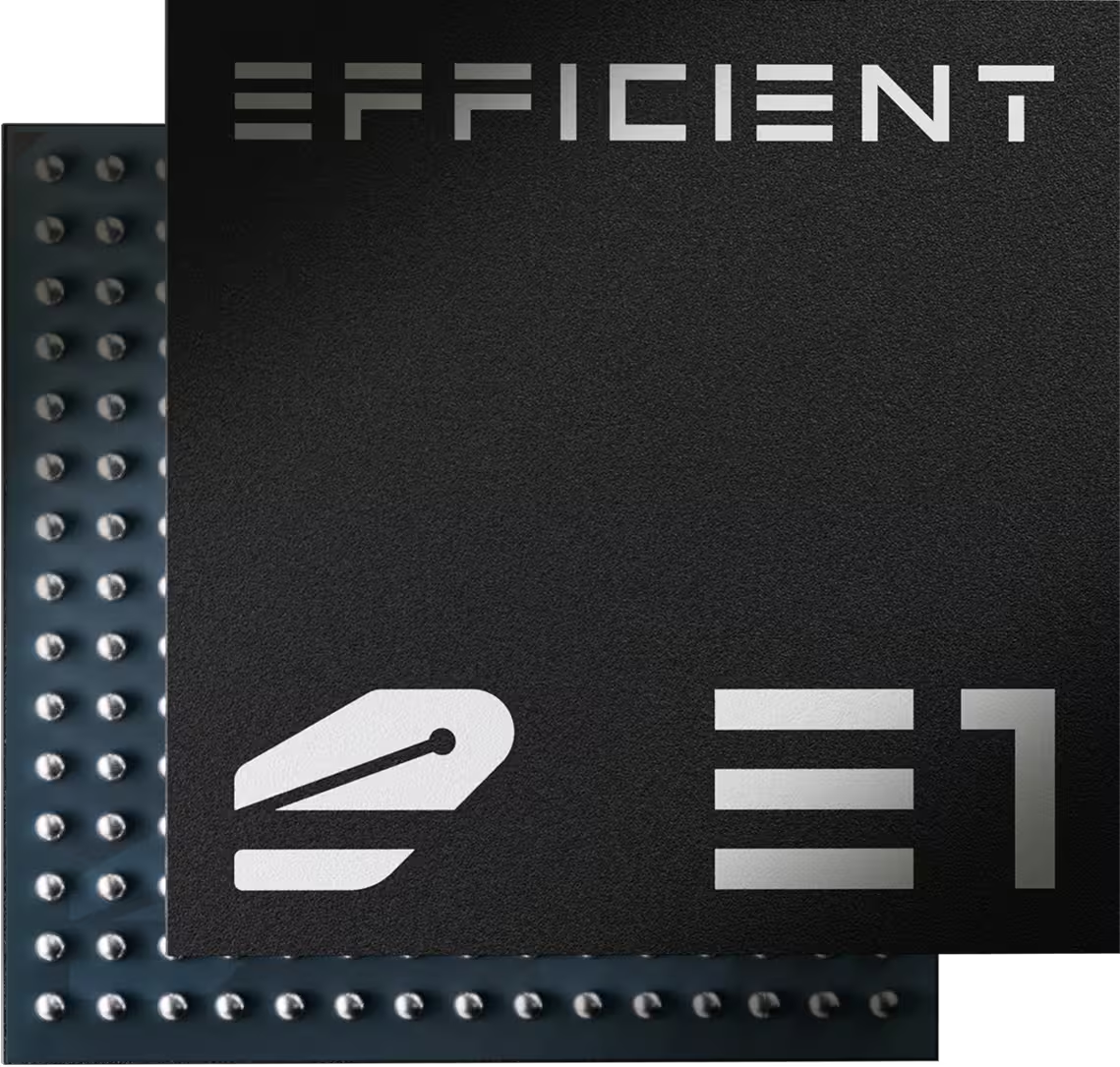
A closer look at the Electron E1
.svg)
.svg)
Why choose the Electron E1?
Efficiency starts with our processor
Up to 100x the energy efficiency of in-market efficient CPUs on whole applications, not just single kernels. Unlock longer runtime on the same battery, or the same runtime on a smaller one.

It adapts with your models
Fixed inference blocks age out when your model evolves. With the Electron E1, a new model is a recompile and an over-the-air update, so your products get better instead of older.
One architecture for any application
From Physical AI to wearable devices, product designers can deploy the Electron E1, ensuring consistent, powerful performance on any platform.

.svg)
Space and defense operations
In orbit, every extra watt of compute means a heavier and more expensive spacecraft. The Electron E1 processes more on board and downlinks only mission-critical findings in standard C and C++. Design the mission, not new hardware.
Heading 1
Heading 2
Heading 3
Heading 4
Heading 5
Heading 6
Lorem ipsum dolor sit amet, consectetur adipiscing elit, sed do eiusmod tempor incididunt ut labore et dolore magna aliqua. Ut enim ad minim veniam, quis nostrud exercitation ullamco laboris nisi ut aliquip ex ea commodo consequat. Duis aute irure dolor in reprehenderit in voluptate velit esse cillum dolore eu fugiat nulla pariatur.
Block quote
Ordered list
- Item 1
- Item 2
- Item 3
Unordered list
- Item A
- Item B
- Item C
Bold text
Emphasis
Superscript
Subscript

Infrastructure observability and industrial automation
A remote sensor shouldn’t drain its battery streaming raw data to the cloud without an event. By enabling real-time data processing and predictive maintenance, The Electron E1 improves operational efficiency and reduces manual oversight.
Heading 1
Heading 2
Heading 3
Heading 4
Heading 5
Heading 6
Lorem ipsum dolor sit amet, consectetur adipiscing elit, sed do eiusmod tempor incididunt ut labore et dolore magna aliqua. Ut enim ad minim veniam, quis nostrud exercitation ullamco laboris nisi ut aliquip ex ea commodo consequat. Duis aute irure dolor in reprehenderit in voluptate velit esse cillum dolore eu fugiat nulla pariatur.
Block quote
Ordered list
- Item 1
- Item 2
- Item 3
Unordered list
- Item A
- Item B
- Item C
Bold text
Emphasis
Superscript
Subscript
.svg)
Physical AI autonomy
On a drone, energy spent on compute is energy not spent on flight. The Electron E1 runs the whole autonomy pipeline on one part. You get a smarter device with less weight, longer flight times, and decreased cost.
Heading 1
Heading 2
Heading 3
Heading 4
Heading 5
Heading 6
Lorem ipsum dolor sit amet, consectetur adipiscing elit, sed do eiusmod tempor incididunt ut labore et dolore magna aliqua. Ut enim ad minim veniam, quis nostrud exercitation ullamco laboris nisi ut aliquip ex ea commodo consequat. Duis aute irure dolor in reprehenderit in voluptate velit esse cillum dolore eu fugiat nulla pariatur.
Block quote
Ordered list
- Item 1
- Item 2
- Item 3
Unordered list
- Item A
- Item B
- Item C
Bold text
Emphasis
Superscript
Subscript

Wearable technology
In wearable devices, the Electron E1 extends battery life while supporting high-performance health monitoring and safety tracking for long-term use. It runs complex multi-modal AI models without hitting the strict thermal and energy limits that traditionally constrain wearables.
Heading 1
Heading 2
Heading 3
Heading 4
Heading 5
Heading 6
Lorem ipsum dolor sit amet, consectetur adipiscing elit, sed do eiusmod tempor incididunt ut labore et dolore magna aliqua. Ut enim ad minim veniam, quis nostrud exercitation ullamco laboris nisi ut aliquip ex ea commodo consequat. Duis aute irure dolor in reprehenderit in voluptate velit esse cillum dolore eu fugiat nulla pariatur.
Block quote
Ordered list
- Item 1
- Item 2
- Item 3
Unordered list
- Item A
- Item B
- Item C
Bold text
Emphasis
Superscript
Subscript
What will you create when energy is no longer the trade-off?
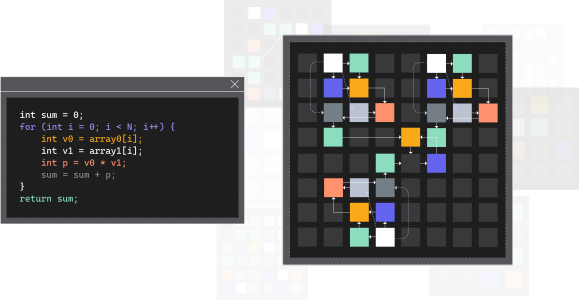
The Electron E1 is powered by our Fabric architecture, a spatial dataflow design that eliminates the bottlenecks of traditional step-by-step execution. Developers still get the familiar programming experience they expect—but with dramatically higher energy efficiency.
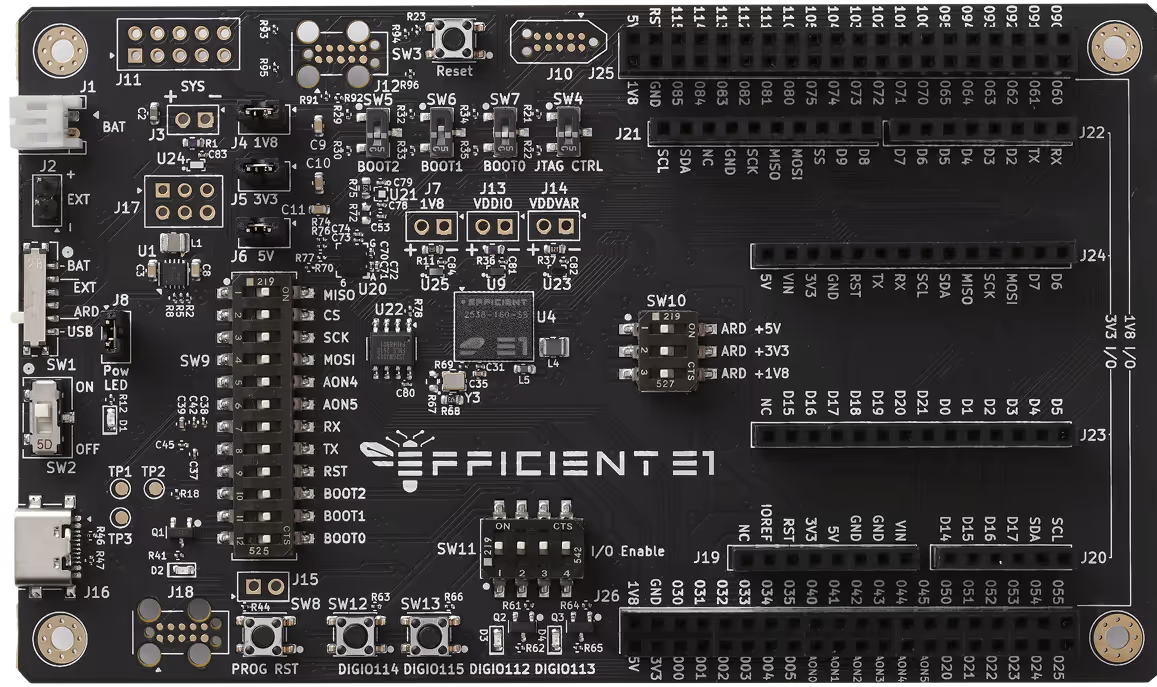
The Electron E1 EVK is designed to make it as easy as possible to explore that potential. Whether you’re bringing up new firmware, running power characterization, or porting existing software, the Electron E1 EVK delivers everything you need. With built-in energy instrumentation, Arduino-compatible expansion, and a complete SDK with quick-start documentation, the EVK lets you harness the power of the Fabric in minutes.
Everything you need to know before designing with Electron E1.
What is the Electron E1, in one sentence?
The Electron E1 general-purpose processor is a complete energy-efficient part built on the Fabric architecture: a spatial dataflow grid that runs your application, on-chip memory and storage, and a standard peripheral set, programmed in C and C++.
Will it talk to the sensors and radios I already use?
Yes, over the standard serial interfaces and general-purpose input-output you already design with. There is no proprietary bus to design around and no vendor bridge chip to add. Download the Electron E1 product brief for specifications.
What power modes does it have?
A programmable power management unit and wake-up controller, with efficiency, performance, low-power, sleep and deep-sleep modes.
Can it run neural network models?
Yes. LiteRT and ONNX models are supported through an import step that turns the model into code the effcc Compiler builds like any other source, so inference runs on the Fabric alongside the rest of your application rather than on a separate accelerator block.
What happens when a better model comes along after the device ships?
You recompile and send an over-the-air update. Models and frameworks move faster than product refreshes, and a device built around a fixed inference block ages out when the model you want no longer fits it, which leaves a working fleet in the field that cannot be improved. On the Electron E1 a new model goes through the same import and build step as the first one, and the devices your customer already paid for take the new build and keep going.
How do I measure energy on my own workload?
The Electron E1 Evaluation Kit has four integrated current sensors covering the system rail, the 1.8 V rail, input-output, and a variable rail you can point at one subsystem at a time, the Fabric and the peripherals among them. It streams real-time energy as comma-separated values, and switches and jumpers let you isolate subsystems for measurement accuracy. The free Energy Profiler on Efficient Labs reports energy for named regions of your code.
What is in the Evaluation Kit?
The kit ships with an evaluation board, a USB-A to USB-C cable, pre-loaded demo firmware, quick-start documentation and software development kit access. It has 72 general-purpose input-output pins, is Arduino UNO and MKR shield compatible for digital functions, runs from 1.8 V to 5.5 V, and takes power from USB, a JST battery connector, an external supply or Arduino VIN, with a USB programmer and JTAG on board. There is also a Cloud Evaluation Kit if you would rather not wait for hardware.
What is the Cloud Evaluation Kit?
Silicon you can reach without waiting for a board. You compile your own code and run it on an Electron E1 remotely, so you can put a real workload on the part today rather than after a shipment clears. Teams typically start there and move to the physical kit when they need to drive their own sensors or measure energy on their own board.
Can I estimate battery life for my device before I have hardware?
Yes. The Lifetime Modeler on Efficient Labs is free and needs no login. It takes your duty cycle and battery capacity and models device lifetime from measured kernel energy. Treat the result as a model built on measured energy, not as a measured battery life.
How do I program and debug the board?
Over USB. The board carries a USB-based programmer and JTAG, so you flash from your host and debug in place. Compile with `-g` for source-level debug information and you get breakpoints, watchpoints and variable inspection from a standard debugger. Pre-loaded demo firmware runs out of the box, so you can confirm the board is alive before your own code is ready.
What software do I need, and where do I get it?
The effcc Compiler and the software development kit that comes with the kit. Toolchain downloads and developer documentation are on our website, so sign up for access. Free browser tools on Efficient Labs, the Board Viewer, Pin Mapper, EVK Getting Started Guide, Energy Profiler and Lifetime Modeler, need no login either.
Stay up to date with our latest features and releases
